Under Armour clothes are produced through a global manufacturing network. Jordan, Vietnam, Indonesia and Cambodia are major production countries in its latest annual disclosure. The location for a specific garment should be checked on that item’s origin label.
The brand’s headquarters, a retailer’s address and the shipping warehouse tell you different things. None identifies where every Under Armour T-shirt, hoodie or pair of training shorts was manufactured.
For buyers comparing a sportswear manufacturer, the useful lesson is to assess company location, production location and product specifications separately.
What Does Under Armour’s FY2026 Manufacturing Report Show?
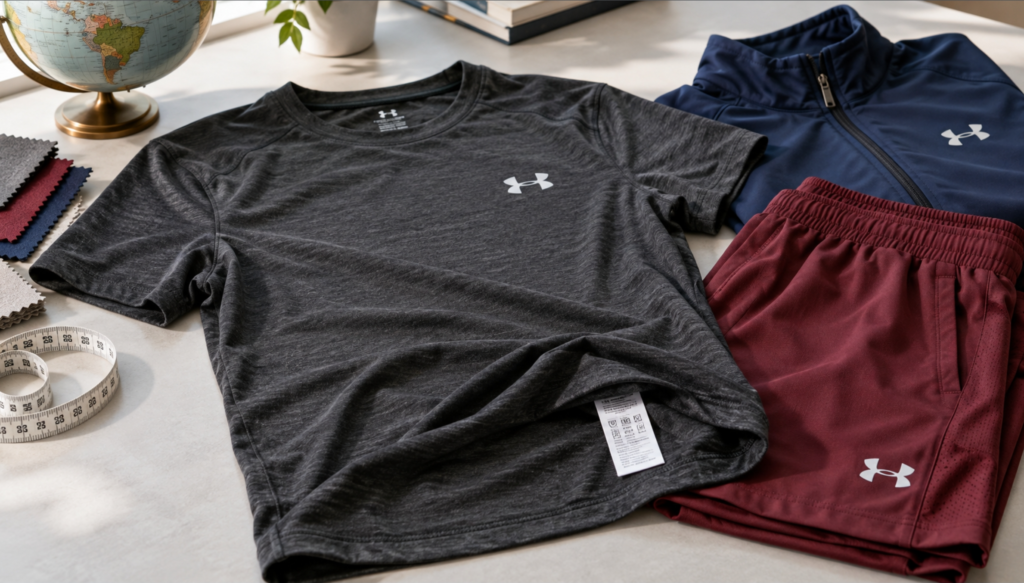
Under Armour’s FY2026 annual report on Form 10-K covers the year ended March 31, 2026. Its sourcing disclosure provides the following figures:
| Disclosure | FY2026 information |
|---|---|
| Primary contract manufacturers for apparel and accessories | 40 |
| Countries where those manufacturers operated | 17 |
| Four major production countries | Jordan, Vietnam, Indonesia and Cambodia |
| Combined share manufactured in those four countries | Approximately 65% of apparel and accessories |
The percentage combines apparel and accessories. It is not a clothing-only percentage, and it does not provide a separate share for each of the four countries.
These figures describe the network for that reporting year. They do not identify the factory or country for a particular item in your shopping basket.
Why Does Under Armour Use Several Production Countries?
Different garments require different materials, construction methods and production capabilities. A fitted training top, fleece hoodie and woven short are separate manufacturing briefs, even when they carry the same brand.
Under Armour says substantially all its products are made by unaffiliated manufacturers. That describes a contract manufacturing model, rather than one central factory producing the entire range.
For an independent brand, sportswear fabric sourcing is part of this wider decision. Fabric availability, processing, sample development and garment assembly need to work together.
When reviewing a supplier proposal, ask which facility will make the garment and who manages the materials. An office location or attractive product photograph does not answer those questions.
How Can You Find Where a Specific Under Armour Item Was Made?
Under Armour’s help information directs customers to the small tag inside the product for its location of origin.
Check the actual garment when possible:
- Find the internal labels. The origin information may appear with the care or fiber-content details.
- Read the country statement. Look for wording such as “Made in” followed by the country.
- Match the exact item. Record the style code, size and other identifying details before comparing listings.
- Check an unclear listing with the seller. Ask for a clear label photograph or confirmation for the item being supplied.
A product page that says “Imported” does not identify a particular manufacturing country. A dispatch address identifies where the parcel starts its journey, which may be a different place.
For second-hand shopping, photos of the internal labels are more useful than a seller’s general description. Keep the comparison tied to the specific garment rather than another item from the same product family.
Are Under Armour Clothes Made in the USA?
Under Armour is an American brand associated with Baltimore, but that does not establish US manufacture for every product.
Its FY2026 disclosure identifies a multinational production network and several major production countries outside the United States. The practical answer for an individual garment remains its origin label.
If US manufacture is a purchasing requirement, verify the specific item with Under Armour or the seller before buying. Avoid applying a claim from one garment to the whole collection.
The same distinction applies when ordering teamwear. Confirm the proposed product and production arrangement directly; the brand name alone is not an origin specification.
Does the Country of Origin Prove Authenticity?
Country of origin is one piece of product information. It cannot, by itself, establish whether a garment is authentic.
A label showing one of the countries in the annual report is consistent with the disclosed network, but a label can be copied. A country outside the four major locations also needs context, because those four countries are not the entire network.
Assess the seller, product details, labels and purchase documentation together. If the item’s origin information is unclear or inconsistent, ask Under Armour for help rather than treating an online country list as an authentication tool.
Also separate authenticity from condition. A genuine second-hand item may be worn, altered or missing labels, which limits what you can verify from photographs.
Does Production Country Determine Clothing Quality?
A country name does not specify the garment’s fabric, fit, stitching or expected use. Quality depends on the actual product and the controls applied to it.
Under Armour states that it evaluates manufacturers for areas including quality systems and social compliance. That is a company-level description of its supplier process, not a performance report for each garment.
When comparing custom performance T-shirts for your own range, inspect the material, seam finish, measurements and behavior after washing. Request the same information from every shortlisted supplier.
A more useful comparison is between products intended for the same activity and price position. A casual cotton tee and a fitted training top may have different requirements, regardless of their production countries.
What Can Sportswear Buyers Learn From This Sourcing Model?
Define the Product Before Choosing the Partner
Specify the wearer, sport, fit, fabric direction and intended retail position. “A technical T-shirt” is too broad to establish a consistent quotation.
For OEM gym apparel development, provide the tech pack or clearest references you have. Confirm which development tasks belong to your team and which the manufacturer will handle.
Approve Materials and Fit Through Samples
Review samples using the intended activity, carrying setup and care instructions. Include the size range when deciding which fit checks are needed.
Before approving bulk training apparel, resolve material, measurement, construction and branding changes. Retain a clearly identified approved reference for production.
Compare the Full Order, Not Just the Unit Price
Request a quote against the same product list, quantity split, packaging and delivery destination. Confirm sampling costs, repeat-order arrangements and the production location.
A supplier’s ability to make sportswear does not establish access to another brand’s products. Your sourcing brief should describe your own collection and the services needed to produce it.
How Can GOFITAPPAREL Support an Own-Brand Sportswear Range?
GOFITAPPAREL is a China-based sportswear manufacturer supporting OEM, ODM and private label activewear projects.
Its role is to help buyers develop their own products, with fit, fabric, construction and branding requirements agreed for the project. A useful inquiry includes the product category, target customer, design files or references, size range, colors, quantity and delivery target.
If you are also comparing sportswear manufacturers in China, use the same specifications and sample criteria across the shortlist.
For an Under Armour purchase, verify the exact garment’s label. For your own brand, use production country as one part of a clearly defined manufacturing brief.