Adidas clothes are made in a global network of factories. Cambodia, Vietnam and China led its apparel sourcing in 2025, accounting for 20%, 18% and 17% of clothing volume respectively. Check the garment’s origin label to identify where a particular item was made.
That distinction explains why an adidas T-shirt does not need a German origin label simply because adidas is a German company. It also explains why a general list of adidas manufacturing countries can be misleading when the question is specifically about clothing.
This guide uses the company’s 2025 annual report and its supplier disclosures available in October 2026. For brands choosing a sportswear manufacturer, it also explains how to distinguish a finished-garment factory from other suppliers in a production network.
Which Countries Make the Most Adidas Clothing?
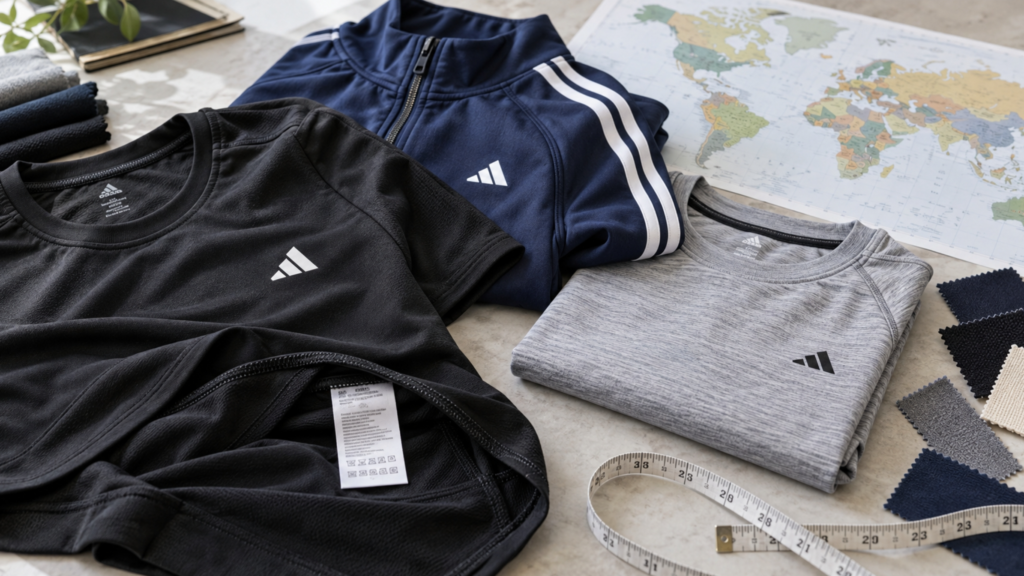
The most useful starting point is the apparel chart in adidas’ 2025 annual report, rather than the headline figure for all products combined.
| Apparel sourcing country or group | Share of adidas apparel sourcing volume in 2025 |
|---|---|
| Cambodia | 20% |
| Vietnam | 18% |
| China | 17% |
| Other countries combined | 45% |
These are apparel-volume shares, not percentages of clothing revenue, numbers of factories or estimates for 2026. The three named countries together account for 55% of the reported apparel volume.
The distinction between product categories changes the answer. Vietnam accounted for 27% of adidas’ total sourcing volume in 2025, but its apparel share was 18%. Using the 27% figure to describe adidas clothing would mix clothing with footwear and accessories.
For shoppers, the table gives a broad picture of the supply network. It does not tell you where a particular hoodie, shirt or pair of track pants was produced.
What Other Countries Appear in Adidas’ Apparel Supply Network?
Adidas’ July 1, 2026 factory disclosure contains separate worksheets for primary suppliers, licensees and wet-process suppliers. Filtering the primary-supplier worksheet for entries categorized as Apparel shows a wider geographic spread than the three countries highlighted in the annual report.
Examples include the following:
| Country or country group | What the July 2026 disclosure confirms |
|---|---|
| Cambodia, Vietnam and China | Apparel-category supplier entries |
| Indonesia, India and Thailand | Apparel-category supplier entries |
| Pakistan and Jordan | Apparel-category supplier entries |
| Turkey and Portugal | Apparel-category supplier entries |
| Brazil, Mexico and El Salvador | Apparel-category supplier entries |
| Germany and the United States | Apparel-category supplier entries, requiring product-level origin verification |
This is a selection of confirmed supplier locations, not an exhaustive country list or a production-volume ranking. The worksheet includes both primary factories and subcontractors, so an entry can describe a manufacturing operation rather than the complete production of a finished garment.
Use adidas’ official supplier lists to inspect the current disclosure and its definitions. Factory relationships can change after the date recorded in a list.
Are Adidas Clothes Made in Germany or the USA?
Adidas’ headquarters are in Herzogenaurach, Germany. That establishes the company’s location, not the origin of every garment carrying its name.
The July 2026 primary-supplier worksheet includes German and US entries categorized as Apparel. However, a supplier-directory entry is not proof that a specific retail item qualifies for a “Made in Germany” or “Made in USA” label. The listed facility’s role and the production history of the item still matter.
For a German-made or US-made purchase, ask to see the actual garment’s country-of-origin statement. A German company address, US seller address, national-team design or warehouse location answers a different question. None of those details should replace the origin information for the item being sold.
Are Adidas Clothes Made in China?
Yes. China appears in adidas’ apparel sourcing data and in its apparel supplier disclosures. A Chinese origin is therefore compatible with genuine adidas clothing.
It does not follow that every item carrying a Chinese label is authentic. The same applies to labels naming Vietnam, Cambodia or any other country. A country name identifies an origin claim; it does not independently verify the seller, the brand authorization or the product.
When evaluating an item, consider its purchase source and whether its article information matches the garment. If a seller claims that adidas clothing made in China must be fake, ask for evidence about the particular item rather than accepting a country-based conclusion.
Does Adidas Own the Factories That Make Its Clothes?
Adidas reports that almost all its production is outsourced to independent manufacturing partners. A factory making adidas goods is therefore not necessarily owned by adidas.
The company’s public supply-chain information also distinguishes direct sourcing, indirect sourcing and local-market production. In direct sourcing, adidas has a contractual relationship with its core suppliers. Other arrangements can involve agents or licensees.
The practical distinction is between the brand, the company managing production and the facility performing a particular operation. One manufacturing group may operate several sites, and a primary supplier may use a subcontractor for specialist work.
For a business choosing a custom sportswear factory, this is a useful question to ask directly: which facility will make the garments, which operations are performed there, and which operations may be subcontracted?
Why Does Adidas Source Clothing From Different Countries?
Adidas describes both a global manufacturing network and a local-for-local sourcing approach. Its 2025 report identifies increased local sourcing in markets including Greater China, India, Brazil and Argentina, intended to improve responsiveness to local demand.
One practical implication is that the destination market can influence the production route. For your own sourcing brief, consider product requirements, available manufacturing capacity, intended sales market and delivery needs together.
It would be too simple to describe every location as merely the cheapest place to sew a shirt. The published sourcing model involves established supplier relationships, technical specifications and market needs.
It also means a factory count cannot be treated as an output ranking. Several small facilities and one large production site may contribute very different volumes. Use the annual report for reported sourcing shares and the factory disclosure for supplier locations and roles.
How to Check Where Your Adidas Garment Was Made
Start with the item itself, then use the other documents as context.
Read the Country-of-Origin Statement
Inspect the labels inside the garment, including the neckline and care-label area where present. Look for an explicit origin statement rather than assuming that a business address is the manufacturing location.
For clothing sold in the United States, the FTC’s apparel-labeling guidance explains that most textile and wool products must identify fiber content, country of origin and the manufacturer or another responsible business. Those are separate pieces of information.
An origin label also should not be treated as a complete map of the material supply chain. Fabric manufacturing, garment production and other processing can involve different suppliers. Read any qualified wording on the label instead of simplifying it into a claim about every component.
Record the Article Information
Note the article number, product name, size and color information available on the garment or purchase record. Adidas uses article numbers to identify products; these details help you ask about the correct style.
Matching an article number is a useful identification step, not a standalone authentication method. Labels and product information need to be assessed together with the purchase source.
Ask About the Actual Stock Being Sold
Before an online purchase, ask the retailer for a clear photograph of the origin label on the item or stock they will supply. A generic catalog photo may not show that information.
If two garments have different origin statements, first compare their article details, product versions and purchase records. Ask the retailer or adidas to clarify an unresolved difference. A different country name alone does not establish that one item is counterfeit.
Does the Manufacturing Country Determine Quality or Authenticity?
A country label gives useful origin information, but it is not a measured quality score. Assess the garment you are buying: its material, fit, construction, decoration and condition.
For shoppers, the first question is whether the specific product suits its intended use. A training top, an insulated jacket and a lifestyle sweatshirt have different requirements. Compare their actual descriptions and construction rather than assigning one quality level to an entire country.
For brands planning bulk sportswear production, turn those requirements into a specification. Define the fabric, size tolerances, seams, artwork and testing needed for the product, then assess an approved sample against that brief.
Authenticity is a separate assessment. Buying through adidas or a reputable retailer, retaining the purchase record and checking the product information provide a clearer basis for an enquiry than country-based assumptions. A label naming a known sourcing country is consistent with the network; it is not proof of authorization by itself.
What Can Private Label Brands Learn From Adidas’ Sourcing Model?
The useful lesson is to make sourcing decisions around a defined product and a verifiable production route.
When discussing a collection with wholesale sportswear suppliers, ask about the garment category and the factory’s role before comparing quotations. A supplier that handles one category or operation may not provide every capability your project needs.
Put the following details in the brief:
- Product type, target wearer and intended activity.
- Fabric, trims, artwork and construction requirements.
- Size range, measurements and sample-review criteria.
- Production location and any proposed subcontracting.
- Order quantity, labeling, packing and delivered-cost basis.
- Required delivery date and arrangements for repeat orders.
A large brand’s public supplier list can help you understand the structure of its network. It does not establish that a listed supplier accepts small private label orders, offers a particular MOQ or will reproduce the same product for another customer. Confirm those commercial conditions for your own project.
GOFITAPPAREL: Developing Sportswear Under Your Own Brand
GOFITAPPAREL is a China-based sportswear manufacturer offering OEM, ODM, private label and wholesale services. Its development offer covers product briefs, fabric and trim choices, pattern and fit work, branding and preparation for production.
For buyers seeking a private label activewear supplier, a useful first submission is a tech pack, original design, sketch or reference that communicates the required function and fit. Include the target market, size range, quantity and launch date so the development route can be reviewed.
Compare the proposed sample and quotation with the same specification used for other suppliers. This is an option for developing original products under your own brand; GOFITAPPAREL is not presented here as an adidas supplier.
Check the Apparel Data, Then Check the Garment
For a particular purchase, start with the garment’s origin statement and ask the seller about anything unclear. For a sourcing project, inspect the supplier’s role, production route and ability to meet your specification. Those checks give a more useful answer than assuming that a German brand must make every shirt in Germany.