Purpose-designed polyester fabrics are usually a practical starting point for sweaty training, running and sublimated teamwear. Cotton is worth considering for casual sports T-shirts, light activity and pieces where a familiar cotton feel is part of the product brief. Blends can serve either direction, depending on their construction.
The important distinction is between a fiber and a finished fabric. “Polyester” or “cotton” on a label does not establish airflow, drying speed, stretch or comfort for every garment.
For brands evaluating sportswear fabric sourcing, choose the intended product and activity first, then compare candidate fabrics against those requirements.
Polyester vs Cotton for Sportswear: Quick Comparison
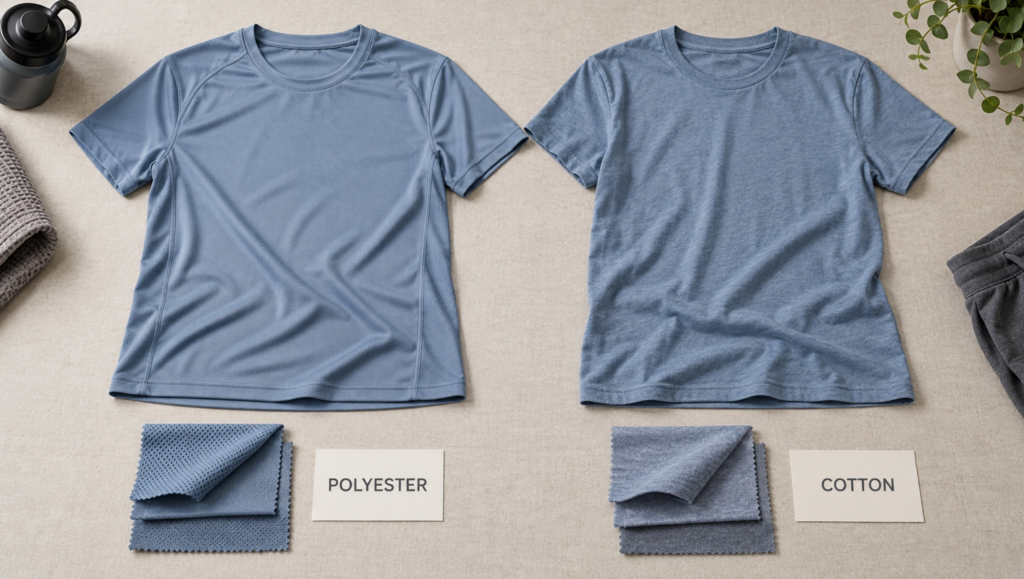
| Requirement | Polyester fabric direction | Cotton fabric direction |
|---|---|---|
| Fiber-level moisture absorption | Low; garment moisture transport depends on fabric engineering | Higher; absorbed moisture can remain in the material |
| Drying after sweating | Often selected for quicker-drying performance garments | Moisture retention needs attention for prolonged sweaty use |
| Airflow | Depends on knit or weave, density and weight | Also depends on construction; fiber name is not enough |
| Hand feel | Can range from smooth and soft to firm or textured | Familiar cotton feel; yarn and finish still affect softness |
| Stretch | Comes from construction and, where used, stretch fibers | Also needs suitable construction or stretch fibers |
| Printing | Conventional dye sublimation commonly targets polyester | Screen printing, suitable transfers and other methods are options |
| Useful starting products | Running tops, training shirts and printed teamwear | Casual sports tees and cotton-feel activity or lifestyle pieces |
These are sourcing directions, not performance guarantees. Compare the actual fabric and finished garment, especially when materials differ in weight, structure or finishing.
Is Absorbing Sweat the Same as Wicking It Away?
No. Absorption means moisture enters or is retained by the material. Wicking describes how liquid moves through a textile. Drying concerns how that moisture leaves it.
Cotton’s ability to absorb moisture can feel comfortable in some situations, but an absorbent fabric can remain damp. Polyester fibers absorb relatively little moisture, yet that alone does not establish effective sweat transport.
Yarn design, construction and finishes influence how a polyester fabric wets and moves liquid. Performance cotton can also be engineered for moisture management.
When assessing custom polyester sportswear fabrics, ask what the supplier has actually tested. A useful report identifies the fabric, test conditions and whether the sample was assessed before or after washing.
A “moisture-wicking” description should be tied to a defined material and method rather than inferred from fiber content.
Which Fabric Is Better for Drying and Long Sweaty Sessions?
For running, repeated training and other activities that leave a garment wet, a suitable polyester performance fabric is often the more useful starting candidate.
The reason is practical: drying and moisture retention affect how the shirt feels as the session continues. Cotton can hold absorbed water, so a fabric that feels pleasant when dry may feel different after sustained sweating.
The comparison still needs controlled conditions. A heavy polyester knit and a lightweight cotton fabric are not interchangeable test samples. Fabric weight, wetting amount, air movement and garment design can all change the outcome.
For a hot-weather range, review ventilation and fit alongside drying. For a cool-weather layer, examine how the garment behaves when damp within the intended clothing system.
Ask a polyester sportswear manufacturer to explain the proposed construction and available evaluation results. Check the approved fabric in a garment before treating a swatch’s behavior as the complete answer.
Which Fabric Feels More Comfortable and Breathable?
Comfort includes several separate experiences: surface feel, temperature sensation, dampness, pressure and ease of movement.
Cotton often suits customers who prefer its familiar hand feel. Polyester can also be soft and comfortable, depending on yarn, construction and finishing.
For cotton fabrics for custom sports T-shirts, compare more than the initial touch. Review weight, drape, wet feel and how the fabric recovers after wear and washing.
Breathability also needs a clearer definition. Air permeability and water-vapor transport are different measurements. An open, lightweight construction can behave differently from a dense fabric made from the same fiber.
Stretch is another separate requirement. Neither fiber name establishes how freely the finished garment will move. Specify the required stretch and recovery for fitted tops or bottoms, then evaluate the fabric and pattern together.
What About Odor, Washing and Durability?
Odor: Assess the Garment and Care Routine
A 2014 study collected T-shirts from 26 participants after a cycling exercise session and assessed them after 28 hours of incubation. The polyester shirts were rated as smelling more intense and less pleasant than the cotton shirts.
That result is useful context, but it does not describe every modern polyester fabric or how a garment smells during exercise. Construction, finishes, use and care remain relevant to the product you are developing.
If odor control is part of the brief, ask for the basis of the claim and review the intended wash routine.
Washing and Durability: Check the Finished Product
Cotton garments can change dimensions if the material and process are not adequately controlled. Polyester garments also need an appropriate care specification, particularly around heat, stretch components and decorative applications.
Both directions should be checked for the properties that matter to the range: dimensional stability, colorfastness, pilling, seam behavior and stretch recovery.
Wash samples according to the proposed care label. Do not assume that a fiber comparison alone establishes which finished garment will last longer.
Is Polyester or Cotton Better for Sportswear Printing?
For colorful, full-body teamwear graphics, conventional dye sublimation is commonly associated with polyester-containing fabrics. The material and printing workflow need to be selected together.
For OEM printed polyester jerseys, review artwork, color, placement and the print process on the approved substrate. Check the finished garment for appearance, hand feel and behavior after washing.
Cotton can work with screen printing, suitable transfer processes and other decoration methods. Choose the process around the design, quantity, stretch and required finish.
Specialist cotton pretreatment or primer workflows can also expand sublimation applications. They require a compatible process and confirmation of availability and wash durability; a standard polyester workflow should not be assumed to give the same result on untreated cotton.
The better printing choice is the tested combination of fabric, artwork and process for the actual order.
Can Polyester-Cotton Blends Offer a Better Balance?
A blend can combine different material characteristics, but the result is not a simple average of the two fiber descriptions.
A 2019 textile study on moisture management in sportswear fabrics found improved moisture-management results in the tested polyester/cotton and polyester/modal blends compared with its tested 100% polyester fabric.
That finding supports testing candidate constructions. It does not establish that every blend is better than every polyester fabric.
For polyester-cotton fabric sourcing for activewear, define the intended balance: hand feel, drying, weight, shape stability, decoration and price position. Then review samples.
Avoid selecting a blend percentage as the entire product specification. Yarn, structure, finishing and garment design still need to be agreed.
Which Fabric Should You Choose for Each Sportswear Product?
| Product or use | Starting direction to evaluate | Main approval points |
|---|---|---|
| Running and sweaty training tops | Purpose-designed polyester performance knit | Moisture transport, drying, ventilation and skin-contact feel |
| Casual sports T-shirts | Cotton or a suitable cotton-containing blend | Hand feel, fit, wash stability and decoration |
| Sublimated team jerseys | Compatible polyester-containing fabric | Print results, color, construction and wash performance |
| Light activity and everyday activewear | Cotton, polyester or blends matched to the customer | Comfort, movement, coverage and repeat wear |
| Fitted training pieces | A fabric with the required stretch and recovery | Pattern compatibility, opacity, seams and wash behavior |
| Warm-up and off-field pieces | Weight and construction selected for the season | Warmth, layering, movement and care |
Use this table to narrow the swatch set. A single collection can contain several fabric directions when the products serve different needs.
The strongest product brief describes what the garment must do. Fiber content is one part of that brief.
What Should B2B Buyers Confirm Before Ordering?
Provide the supplier with a product-level specification:
- Garment type, sport, wearer and intended conditions.
- Fiber composition, structure, target weight and acceptable tolerances.
- Required stretch, recovery, hand feel and coverage.
- Moisture-management, drying or other functions that need evaluation.
- Print or decoration method and approved artwork.
- Care instructions and the agreed sample-approval process.
For bulk polyester sportswear orders, compare quotations against the same material, quantity split, decoration and delivery requirements. Extra finishing or testing can change the quote.
Review custom cotton activewear samples after wear and washing before approving the production reference. Apply the same process to polyester and blended alternatives.
Retailers and distributors should also confirm reorder arrangements. An approved fabric should be identifiable by specification, rather than only by a descriptive name such as “soft cotton” or “quick-dry polyester.”
How Can GOFITAPPAREL Help With Fabric Selection?
GOFITAPPAREL supports fabric selection as part of OEM, ODM and private label activewear development.
Share the garment, target customer, activity, expected functions and design. The material discussion can then address feasibility, sample construction, decoration and the approval criteria for the finished product.
If you are comparing sportswear manufacturers in China, send the same fabric and product requirements to each shortlisted partner.
Choose polyester, cotton or a blend because the approved garment fits its intended use. For performance training, start by testing a suitable polyester construction; for cotton-feel casual pieces, evaluate cotton or blends against the same clear product brief.