For most fans buying a jersey to wear to games, an officially licensed replica is the more practical starting point. An authentic jersey makes more sense when you specifically value its on-field design, construction and details enough to pay the premium.
The important distinction is that replica does not mean counterfeit. An official replica is a legitimate fan product. “Authentic,” meanwhile, can describe a retail product tier; it does not establish that a particular shirt was issued to, or worn by, a player.
This authentic vs replica jerseys guide uses MLB products as its main example, with information reviewed in October 2026. Other leagues and brands use different tier names, so check the exact product rather than transferring a baseball comparison to every sport.
If you are buying uniforms for your own club, the decision changes again. Working with a custom baseball jersey manufacturer involves specifying a playing uniform, rather than choosing a professional team’s retail fanwear tier.
Authentic vs Replica Jerseys: The Main Differences
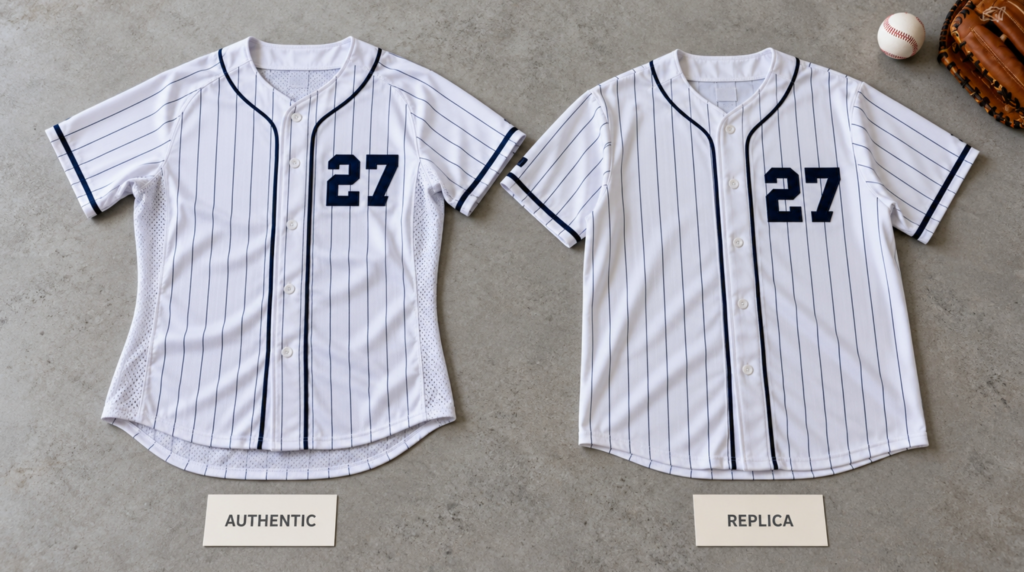
| Question | Authentic retail jersey | Official replica jersey |
|---|---|---|
| What is the purpose? | A premium product built around the on-field look and specification | A fan-oriented version of the team design |
| Who is it most suitable for? | Buyers who prioritize particular construction and uniform details | Fans prioritizing everyday wear and a lower purchase price |
| Is it officially licensed? | Yes, when sold as a legitimate licensed product | Yes, when sold as a legitimate licensed product |
| Is the fit automatically better? | No; length and proportions may suit some buyers better than others | No; assess the actual fit and intended layering |
| Are all details stitched? | Not a reliable universal rule | Not a reliable universal rule |
| Is it game-worn? | A standard retail purchase does not establish game use | No game-use provenance is implied |
| What should you compare? | Exact style, fabric, measurements, patches and decoration | Exact style, fabric, measurements, patches and decoration |
“Better” depends on the job you want the jersey to do. An expensive garment that feels too long for casual wear may be a poor purchase even if its specification appeals to a collector.
What Do Authentic and Replica Mean?
Authentic is a product specification, not player provenance
Retail authentic jerseys are marketed around the professional uniform. Some current listings use “Elite,” while other listings use “Authentic.” The title is a starting point; the product description explains what is actually included.
A retail authentic should also be distinguished from player-issued and game-used memorabilia. Those purchases require their own provenance. A retail jock tag, player name or premium price does not demonstrate that a player wore the garment.
Replica is an official fanwear category
A licensed replica offers a team’s design in a version intended for supporters. It may simplify details or use different materials and proportions.
For example, Nike’s current cream Philadelphia Phillies replica listing describes a loose fit, 100% polyester and a heat-pressed twill wordmark with raised faux stitching. Those are specific design choices in an official product, rather than evidence that the shirt is fake.
Counterfeit is a separate issue
An unauthorized product can imitate either tier. Calling it a “replica” does not make it equivalent to a licensed replica sold through an official channel.
For buyers, the useful checks are the seller, product identification, photographs of the actual item and consistency with the correct style and season. A suspiciously cheap offer is a reason to investigate; price alone cannot authenticate a jersey.
Why MLB Shoppers Now Need to Check More Than Two Tiers
MLB Shop’s current comparison includes four categories: Replica, Limited, Stadium and Authentic. Its advertised starting prices, reviewed on October 15, 2026, were:
| MLB Shop category | Advertised starting price in USD | Position in the comparison |
|---|---|---|
| Nike Replica | $124.99 | Simplified team design for fans |
| Nike Limited | $154.99 | On-field inspiration with fan-oriented comfort |
| Nike Stadium | $179.99 | On-field styling with a relaxed feel |
| Nike Authentic | $324.99 | The premium on-field category |
These are entry prices from the comparison page, not quotes for the same player, color or season. Personalization, special editions, availability and promotions can change the actual price.
Use MLB Shop’s official jersey buying guide to check the categories, then read the selected product page. A store-wide comparison cannot replace the specifications of an individual jersey.
The practical implication is simple: a shopper choosing between the cheapest fan option and the highest-priced option may also have intermediate choices worth trying.
Compare Fabric and Construction at the Product Level
A tier label does not tell you the complete fiber composition. Current Nike product listings illustrate the variation:
| Example reviewed | Listed material | Details relevant to comparison |
|---|---|---|
| Phillies cream Replica, style RP2603K2PP-PV6 | 100% polyester | Loose fit; heat-pressed twill chest wordmark |
| Bryce Harper Phillies cream Limited, style LM2503K2PP9-V91 | 100% recycled polyester | Double-knit mesh; Dri-FIT; faux-stitch name and number details |
| Phillies white Elite, style 90B0PPHOPP-00Z | 95% polyester, 5% elastane | Stretch mesh; Dri-FIT ADV; premium twill details |
These examples are different products, not a controlled test of identical jerseys. They show why “all authentic jerseys use this fabric” or “replicas never have this feature” can mislead.
If a detail matters to you, check it directly: mesh panels, stretch, neckline, sleeve patches, name and number application, hem shape and care instructions. Product-year changes can also make an older comparison inaccurate.
For team buyers, that same lesson should shape custom jersey fabric sourcing. Specify the material and construction required for your players instead of asking for an undefined “authentic quality” fabric.
Is Stitching a Reliable Way to Tell Them Apart?
Not on its own. Modern licensed jerseys can combine embroidery, heat-applied elements, twill and other finishes. Even a premium product may include heat-applied components.
The Nike Elite example above lists a heat-applied MLB Batterman logo. The replica example lists a sewn-down Batterman logo alongside a heat-pressed wordmark. Therefore, “stitched equals authentic” is not a sound classification rule.
Appearance can also be deceptive: faux stitching is intended to resemble a stitched finish. Use the correct product specification and purchase history rather than a single close-up photograph.
For an original uniform order, ask your supplier to name the actual decoration method. A clear specification should distinguish sewn twill, embroidery, heat transfer and sublimated graphics, with a sample showing the agreed result.
Fit, Length and Comfort Matter More Than the Label
Start with how you will wear the jersey. A shirt for an afternoon at the ballpark, worn over a T-shirt, has different practical requirements from a garment you want to tuck into baseball pants.
Measure a comfortable garment you already own. Compare chest width and body length using the seller’s measurement method, and check whether the chart shows body measurements or finished garment measurements.
Do not assume a numeric size in one range is interchangeable with a letter size in another. Also check the particular men’s, women’s or youth version; a shared team design does not establish a shared cut.
For a club order, custom team jersey sizing should be approved across the relevant size range. Record top and bottom sizes separately if the team is also ordering pants or shorts, and have players try the proposed uniform during realistic movements.
Which Jersey Should You Buy?
Choose a replica for regular fan use
Start with a licensed replica if you want recognizable team styling, comfortable casual wear and a smaller budget commitment. This is also a sensible first option for a gift when the recipient has not requested a particular premium specification.
Check fit and returns before personalizing the shirt. The wrong name, size or number can matter more than the difference between product tiers.
Choose authentic when the specific details matter
Consider authentic if you care about the particular on-field design, garment structure or details listed for that release. Compare the actual product with an intermediate tier before deciding whether the difference justifies the additional cost to you.
Do not buy it on an assumption of better resale value. A normal retail jersey and authenticated memorabilia are different purchases.
Consider an intermediate tier when available
Limited or Stadium may be worth examining if Replica omits a feature you want but Authentic exceeds your budget. Try the fit and compare the decoration rather than treating a higher tier as an automatic upgrade in every respect.
Choose a playing uniform for your own team
A professional team’s fan jersey is not a specification for an amateur club’s season. Players need appropriate movement, identification, durability and conformity with their competition’s requirements.
When arranging bulk custom baseball jersey orders, define quantities by style, color and size, and confirm the cost of names, numbers and later replacements. A low blank-garment price may exclude much of the finished uniform.
How Teams and Retailers Can Order Custom Jerseys
Start with your own team identity or artwork you are authorized to use. Custom production should not be presented as licensed MLB merchandise unless the relevant authorization exists.
For a team, provide the season deadline, league requirements, size roster, number list and approved artwork. For a retailer developing an original range, private label baseball jersey production also needs agreed brand labels, care information and packaging.
Approve the completed product before releasing the production order. Custom baseball jersey samples let you review placket alignment, decoration placement, comfort and measurements together. A digital proof can approve artwork, but it cannot demonstrate the feel of the finished shirt.
Keep an approved roster and a version of the final specification for reorders. Confirm whether replacement pieces have different minimums, prices or delivery windows.
About GOFITAPPAREL
GOFITAPPAREL is a China-based sportswear manufacturer with a team apparel offering that includes baseball and softball uniform development. It can be considered for original club, school, retailer or teamwear projects.
Its role here is custom sportswear product development and production, rather than a claim to supply licensed MLB retail jerseys. Buyers should submit their own approved designs, expected quantities and playing requirements for a project review.
A useful inquiry describes the actual garment: fabric, fit, front opening, names and numbers, labels, packing and delivery destination. That gives a manufacturer a clearer basis for a quotation than a request to copy a professional team’s retail jersey.
Frequently Asked Questions
Are replica jerseys fake?
Officially licensed replica jerseys are legitimate fan products. Counterfeit merchandise is a separate category and can imitate different retail tiers.
Is an authentic jersey the same as a game-worn jersey?
No. An authentic retail product does not establish player use. A game-worn claim needs separate supporting provenance.
Are authentic jerseys always stitched?
No. Materials and application methods vary by product and year. Read the exact listing rather than relying on a universal stitching rule.
Is Limited the same as Replica?
Not in MLB Shop’s current comparison. Limited and Replica are listed as separate categories, alongside Stadium and Authentic. Other sports may use different names.
Can I wear a replica jersey to play baseball?
You may find it comfortable for casual activity, but fanwear is not automatically suitable as a competition uniform. Check fit, movement, identification and your league’s requirements before buying for a team.
Conclusion
Choose a licensed replica when everyday fan use, fit and budget are your priorities. Choose authentic when the specific premium design and construction matter enough to justify its price, and compare any intermediate tiers before buying. For your own team, move beyond retail labels: define the uniform’s fabric, fit, decoration and reorder needs, then approve a sample against those requirements.