Men can wear thong swimwear at places where the applicable rules permit it. There is no universal beach or pool policy: some local authorities and swimming facilities expressly prohibit thong styles, while others permit them in defined settings. Check the destination’s rules and the individual venue’s dress code before visiting.
The question is about more than whether a swimsuit covers the front. A beach may have a local clothing restriction, a public pool may require more rear coverage, and a hotel may publish a separate dress code for its pool area.
This guide explains how to check those requirements, using official examples from the United States and Canada reviewed on October 12, 2026. The examples illustrate different policies; they are not a worldwide list of places where thongs are allowed.
For brands working with a men’s swimwear manufacturer, the same distinction matters: a garment can be designed for swimming without being permitted at every beach or pool.
Can Men Wear Thong Swimwear on Public Beaches?
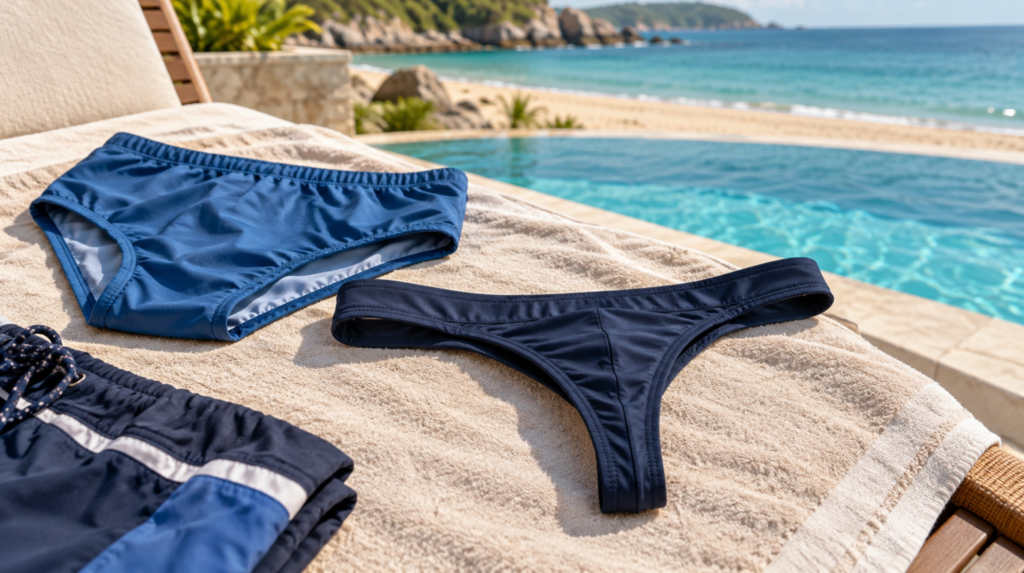
The answer depends on the rules governing the particular beach. Start with the city, county, park service or other authority responsible for the stretch of coastline you plan to visit.
Look for beach regulations, public-exposure provisions and any specific reference to thong bathing suits. A rule may name the garment, or it may describe body areas that must remain covered. Checking only whether nudity is prohibited can miss a more specific restriction.
For example, Horry County’s official beach rules include thong bathing suits within the prohibited-attire provision. The county page identifies the portions of the Grand Strand it manages. That geographic detail matters: do not apply one authority’s rules to every nearby town or beach.
Popular holiday destinations can contain several jurisdictions along the same coastline. Confirm the authority for your beach access or accommodation address rather than relying only on the destination’s marketing name.
Can Men Wear Thong Swimwear at Public Swimming Pools?
A public pool’s swimwear policy needs its own check, even if your swimsuit is permitted at a nearby beach. Pool operators may distinguish between swim briefs, board shorts, underwear, thong styles and other clothing.
Fontana’s published pool guidelines expressly prohibit thong swimsuits. Portland Parks & Recreation also lists G-strings and thong bikinis among its non-approved examples. These are specific facility-policy examples, not evidence that every US public pool has the same rule.
Read Fontana’s swimwear policy and pool guidelines to see how an operator can state the restriction directly.
If another pool uses broad wording such as “appropriate swimwear” or “revealing swimwear,” ask for clarification before buying a ticket. The absence of the word “thong” is not, by itself, confirmation that the style is accepted. Ask about both swimming and time spent on the deck.
What About Hotel Pools, Resorts and Water Parks?
Check the property’s current policy rather than assuming it follows the rules of the nearest public beach. A hotel pool, beach club or water park can have an operating dress code that visitors are expected to follow.
An adults-only description does not tell you which swimsuit cuts are permitted. Likewise, wording about a family environment does not provide a precise measurement for rear coverage. Ask the operator how its policy applies to the actual garment.
Some water parks also restrict particular hardware or clothing on individual attractions. A swimsuit accepted in a pool area may still need to meet separate slide requirements.
When booking, ask where the permission applies: in the pool, on the deck, in a designated sunbathing area, or throughout the property. Bring swim shorts or another approved option for restaurants, reception areas and routes outside the swimming zone.
Real Beach and Pool Policy Examples
These official examples show why a location-specific check is more useful than a blanket answer.
| Location or program | What the published information says | What to check before visiting |
|---|---|---|
| County-managed beaches in Horry County, South Carolina | The county’s beach rules expressly include thong bathing suits within a prohibition | Whether your beach lies within the county-managed stretches listed on the page |
| Fontana aquatic facilities, California | The pool guidelines prohibit thong swimsuits | The current rules for your facility and session |
| Portland Parks & Recreation pools, Oregon | G-strings and thong bikinis appear in the non-approved swimwear list | How the rule applies to the cut you intend to wear |
| Vancouver’s 2STGD Swim and Gym program, British Columbia | The program’s swimwear information explicitly accepts thongs, requires genital coverage and excludes see-through underwear | Program participation requirements and the current session information |
The Vancouver example is particularly important to read in context. The City of Vancouver’s program guidance describes a designated Two-Spirit, Trans and Gender Diverse swim program with specific participation conditions. It should not be presented as blanket permission for every pool or every visitor in Vancouver.
Recheck the relevant page before your visit. A policy example in an article is a starting point for verification, not a substitute for the current rule at your destination.
Does a Thong Ban Also Apply to Swim Briefs?
Not necessarily. A conventional swim brief and a thong can provide different rear coverage, and a facility may list them separately.
For example, Fairfax County Park Authority’s swim-attire guidance lists swim briefs among approved examples and thong bikinis among prohibited examples. That distinction is useful when choosing an alternative, but it should not be extended to an unrelated facility.
Product names are not precise policy definitions. “Bikini brief,” “cheeky,” “Brazilian,” “thong” and “G-string” can be used differently by sellers. Show the venue front and back product images if the wording is unclear.
Also distinguish a swim thong from thong underwear. Similar-looking garments can have different intended uses, and some pools specifically exclude underwear. Check that the product is sold and constructed for swimming, then confirm that its coverage meets the venue’s requirements.
How to Check the Rules Before You Go
Use this short sequence before a beach day or pool booking:
- Identify the exact location. Find the beach authority, pool operator or property, including the specific access point or facility.
- Read the official policy. Search its website for swimwear, dress code, beach rules, pool rules and public exposure. Use the current page rather than a travel forum as the final reference.
- Look for coverage and garment restrictions. Check both named styles and requirements concerning covered body areas, transparency or swim-specific clothing.
- Ask about your garment and session. Explain the cut and offer product photos. Confirm whether the answer covers the water, deck and sunbathing area.
- Pack an approved alternative. Choose the backup against the same policy. Swim briefs are not automatically accepted wherever thongs are prohibited.
A useful message to the operator is:
I plan to wear a men’s thong swimsuit with full front coverage and a narrow rear panel. Is this permitted in the water and on the pool deck during [session or visit date]? I can send front and back product photos if helpful.
Keep the reply with your booking details and read any posted updates on arrival. A response about one venue or session does not establish permission elsewhere.
Choose Swimwear That Maintains Coverage in Water
Once the venue confirms that the style is permitted, assess the garment itself. A swimsuit’s appearance in a dry product photo does not tell you everything about its fit in use.
Check Front Coverage and Secure Fit
The front panel should maintain the required coverage when you sit, bend, walk and swim. Check that the waistband stays in place and that the garment does not need continual adjustment.
Use the product’s measurements and fit information. For brand buyers comparing men’s swimwear suppliers, assess the intended size range rather than approving every size from one fitting sample.
Review Opacity When Wet and Stretched
Look for clear information about lining and intended water use. If possible, assess the actual garment after wetting, with the fabric stretched as it will be during wear. Front coverage should not depend on remaining dry or standing still.
Treat this as a practical review of the chosen garment, color and size. A fiber blend or a “swimwear” label alone does not establish wet opacity, secure fit or permission to enter a venue.
Match the Style to the Activity
Check comfort and stability for what you plan to do: sunbathe, swim laps, play in the surf or use water slides. A garment that feels secure while standing may behave differently during movement.
Style preference is personal. Venue rules and garment performance can be checked without making assumptions about a wearer’s body type, confidence or identity.
What Swimwear Brands and Retailers Should Tell Customers
Brands can make this decision easier by showing accurate front and back views, identifying the intended water use, and describing coverage and lining clearly.
Buyers sourcing wholesale men’s swimwear should request those details before ordering a collection. A customer-facing product page needs enough information to compare the cut with a venue’s policy.
Avoid a universal claim such as “legal at all public beaches” or “approved for every pool.” Acceptance is a location-specific question that a garment seller cannot establish from the product specification alone.
When developing a collection with a private label swimwear supplier, include coverage, fit and product descriptions in the approval brief. Offering clearly differentiated thong, fuller-coverage brief and short styles gives customers alternatives without implying that every style is accepted everywhere.
GOFITAPPAREL: Developing Swimwear Around Its Intended Use
GOFITAPPAREL’s custom swimming-apparel services cover product development around fit, lining, movement and wet-state coverage. Its published offer includes men’s swim briefs and jammers, alongside private label swimwear development.
For buyers seeking a custom swimwear factory, the starting brief should identify the target customer, water environment, desired cut, size range and coverage requirements. Discuss the feasibility of a proposed style, then review its sample before approving bulk production.
Product development can address the garment’s specification. Permission to wear it remains a separate check with the relevant authority or venue.
Choose the Venue First, Then the Swimwear
Men can wear thong swimwear where the applicable rules allow the style. The practical decision comes from the exact beach or facility, the session being attended and the coverage of the garment.
Check official rules, clarify vague wording and bring an approved alternative. That preparation gives you a much firmer answer than a general claim about what is normal across a country or what another visitor wore last summer.