Men play best-of-five sets and women play best-of-three in Grand Slam singles because the tournaments have retained different match formats shaped by their history and governing decisions. The difference is a competition rule, not proof that women cannot play longer matches.
There is also an important correction to the question: men do not always play five sets in professional tennis. Regular ATP and WTA Tour singles matches generally use best-of-three. At the majors, a man needs to win three sets and a woman needs to win two; neither has to play the maximum if the match finishes sooner.
Understanding why men play 5 sets and women 3 means separating the current rules from the history behind them—and from the debate about what should happen next.
These rules also matter to clubs and academies planning match-day kit with a custom tennis apparel supplier: start with the format of your own event, then define the clothing brief around the players and conditions.
Rules and source information checked October 16, 2026.
Do Men Always Play Five Sets in Tennis?
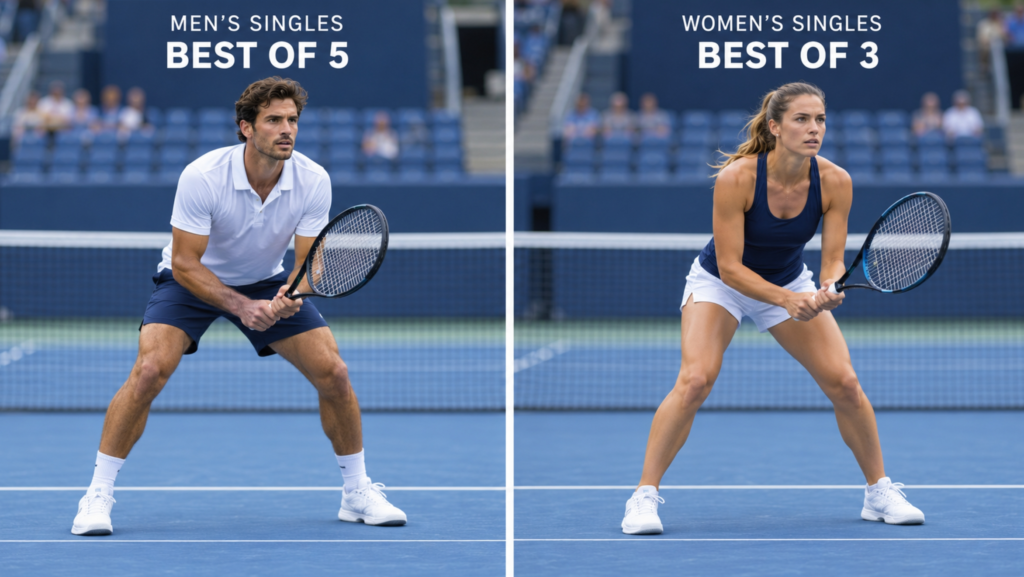
No. The format depends on the competition and event.
| Singles competition | Match format | Sets needed to win |
|---|---|---|
| Men’s Grand Slam main draw | Best-of-five | Three |
| Women’s Grand Slam main draw | Best-of-three | Two |
| Regular ATP Tour events | Best-of-three | Two |
| Regular WTA Tour events | Best-of-three | Two |
The four Grand Slams are the Australian Open, Roland-Garros, Wimbledon and the US Open.
The WTA’s explanation of tennis scoring and match formats makes this distinction between tour matches and the majors.
“Five sets” is shorthand for best-of-five, not a scheduled five-set requirement. A completed men’s Grand Slam match can finish 3–0, 3–1 or 3–2 in sets. A completed women’s match can finish 2–0 or 2–1.
These comparisons concern singles. Do not apply them automatically to doubles, mixed doubles, qualifying or junior events, which have their own competition conditions.
Why Are Men’s and Women’s Grand Slam Formats Different?
The difference developed through historical decisions and persists because the tournaments continue to use those formats. There is no single modern rulebook paragraph explaining every historical, sporting and commercial reason.
Historical Decisions and Traditions
Early organizers made decisions about women’s match length without today’s assumptions about equal participation.
The International Tennis Hall of Fame records that Elisabeth Moore played two consecutive five-set matches at the 1901 US National Championships. Its account says those matches prompted the male-dominated United States National Lawn Tennis Association leadership to adopt best-of-three for the women’s championships, disappointing Moore and other players.
That is a documented example of administrators shortening women’s tennis despite women having completed longer matches.
It should be kept in its proper context: an episode in the history of the US championships. It does not establish that every Grand Slam adopted its women’s format through the same decision or on the same date.
Who Sets the Format Today?
The 2026 Official Grand Slam Rule Book specifies best-of-five for men’s singles main-draw matches, with best-of-three as the default for other matches unless an event determines otherwise.
Changing that framework is a governance decision. Under its amendment process, at least three of the tournament members must vote in favor of a change.
A player cannot simply request a different match length on the day. Nor can the WTA alone rewrite the format across all four majors.
This explains why a historical distinction can continue even while players disagree about its merits: changing it requires an agreed competition structure.
Have Women Ever Played Best-of-Five Matches?
Yes. Five-set women’s tennis is part of the sport’s recorded history.
Beyond the early US example, the WTA’s own historical summary confirms that the year-end championship final used best-of-five from 1984 through 1998.
One clear example is the 1990 final, when Monica Seles defeated Gabriela Sabatini:
6–4, 5–7, 3–6, 6–4, 6–2
Seles trailed two sets to one before winning the final two sets. The WTA also records five-set finals involving Steffi Graf against Anke Huber in 1995 and Martina Hingis in 1996.
The distinction is important: these were best-of-five finals, not an entire season or tournament played under that format.
The record answers “Have women played five sets?” It does not, by itself, establish how every player would respond to a full Grand Slam draw using longer matches. That wider decision involves preparation, recovery between rounds and the competition schedule.
It also separates two questions often mixed together: whether players can complete a longer match, and whether a tournament should require that format.
How Do Best-of-Three and Best-of-Five Change a Match?
The clearest difference is the number of sets a player must lose before the match is over.
| Situation | Best-of-three | Best-of-five |
|---|---|---|
| A player loses the opening set | Can still win 2–1 | Can still win 3–1 or 3–2 |
| A player loses the first two sets | Match is over | Can still win 3–2 |
| Both players have won two sets | Not possible in a completed match | A deciding fifth set is needed |
The 0–2 example shows why a five-set comeback is distinctive. The trailing player still has a route back, but must win all three remaining sets.
Longer formats also allow more opportunities to adjust tactics. A player might change return position, vary rally patterns or respond to an opponent’s early success over additional sets.
Best-of-three creates a different kind of pressure: there is less room to recover from a poor start. That does not make a short match less competitive.
Match Length Is Not a Fixed Number of Hours
Set count provides a framework, not a stopwatch.
Long service games, tiebreaks and tightly contested sets can extend a match. A straight-sets result can be relatively quick, while a close match under a shorter format can still demand sustained effort.
Comparisons should therefore distinguish maximum sets, sets actually played and elapsed time. Treating those as the same measure leads to misleading arguments about effort and entertainment.
A Practical Note for Clubs Ordering Tennis Kit
Club competitions do not automatically follow Grand Slam formats. For bulk tennis uniform orders, confirm the actual match schedule, number of players, size breakdown and replacement needs before asking for a quotation.
Base tennis apparel fabric sourcing on the expected weather, stretch and coverage requirements. Agree which performance claims need supporting test results rather than treating a fabric description as proof of suitability.
Before approving production, review custom tennis apparel samples for serving, reaching, lateral movement and ball-pocket access. Record any fit changes and agree the wash-check requirements so the approved garment becomes a clear reference for the order.
Why Is Grand Slam Prize Money Equal Despite Different Formats?
Grand Slam prize money is structured around tournament results and rounds reached, rather than a payment rate for each set or hour.
The US Open’s official 2026 announcement provides a concrete example: the men’s and women’s singles champions were each allocated $5.5 million.
A champion’s award does not increase because a final goes the distance. The winner of a straight-sets final receives the published champion’s prize just as the winner of a longer final does.
That is why counting sets alone cannot explain the prize-money policy. Equal awards are an event’s compensation decision; the match format defines how players compete for those awards.
People can debate whether the formats should match, but that is a separate question from describing how the existing prize table works.
Avoid extending one Grand Slam’s figures to every professional event. Current prize amounts should always be checked against the relevant tournament and year.
Could Grand Slam Match Formats Change?
Yes, formats can change through the sport’s decision-making processes. A public proposal, however, is not an adopted rule.
In its March 5, 2026 coverage, the BNP Paribas Open reported discussion of making women’s Grand Slam matches best-of-five from the quarterfinals onward.
The same article documented different player responses:
- Aryna Sabalenka supported the idea and expressed confidence in her physical readiness.
- Coco Gauff raised scheduling concerns and preferred a consistent format throughout a tournament if a change occurred.
- Jessica Pegula distinguished being capable of playing five sets from believing the format should be required.
Those are individual views, not a single position shared by all women players.
The broader choices include retaining the existing formats, extending women’s matches or shortening some men’s matches. Each changes the tournament in a different way.
A longer format offers additional comeback opportunities. A shorter one can make scheduling more manageable. A format that changes by round introduces a further question: should the same event test players differently as it progresses?
For viewers, the important check is whether an announcement describes a suggestion, a consultation or a formally adopted format. The 2026 rules reviewed for this article retain the men’s and women’s singles distinction; discussion of future changes should not be presented as a confirmed new rule.
Conclusion
Men’s and women’s Grand Slam singles use different formats because historical decisions became established competition structures that the tournaments continue to maintain. Most regular tour singles matches use best-of-three for both, and women’s five-set matches are well documented.
For clubs explaining the sport to new players, the useful starting point is the event’s actual rules. GOFITAPPAREL publishes this guide and provides custom kit development for clubs and academies. To plan a collection, discuss your size range, materials and sample requirements with GOFITAPPAREL, a custom tennis apparel manufacturer. On court, the key distinction remains simple: best-of-five requires three sets to win; best-of-three requires two.